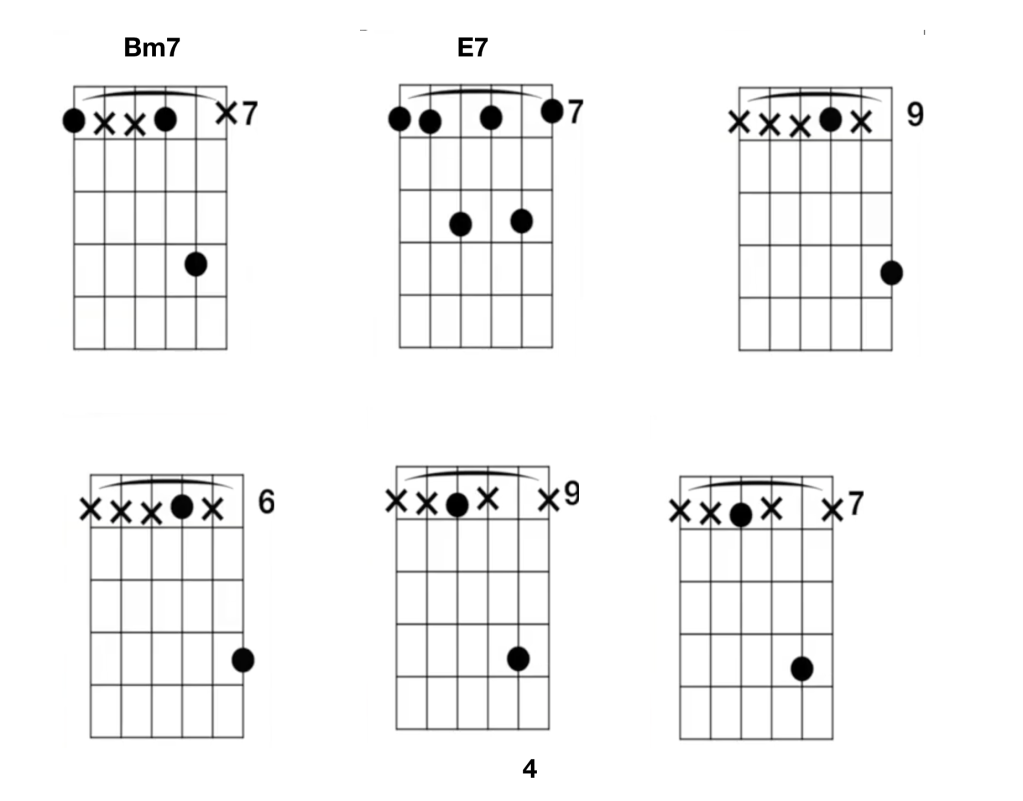
Some Thumb Fun

This is a little thumb-tapping riff I’ve been working into a fuller composition for some time.

Often, I use this as an introduction to a medley I do with pieces by three of my favorite guitarists: Jimi Hendrix (Little Wing), Carlos Santana (Europa) and Stevie Ray Vaughn (Riviera Paradise).

As you’ll see, this is still a work in progress. It begins with the thumb-tapping exercise (hence the title of this blog and the piece itself). I then use a bit of fret tapping with the index finger.

I’m not quite sure about the middle section yet. I’ve been fooling around with this little progression using harmonics, in this case going from a Gm6 to an Am. I’m accomplishing these chords by barring on the third and fifth frets but leaving the high E string open. Then, 12 frets above each of these bar chords, I’m tapping on the frets to achieve the harmonics. Notice, I’m alternating between the bar chord harmonics and hitting the open high E string to achieve that Gm6 chord, which I think has a nice ring to it.

Once I get this finalized, I’ll post an update.
The age-old jazz debate

I was on a social forum the other day, where the perpetual discussion about my favorite music genre was raging.

A member of that forum noted that he had been criticized for describing Bossa Nova as jazz, and wondered whether he was in the wrong or right.

I agreed with the vast majority of the responses: Bossa Nova fits very neatly into the jazz genre. You don’t have to get far in the Real Book to find the very first evidence of that in “Blue Bossa” in Book 1.

Of course, there are purists who will argue that the Real Book does not define jazz. And they are right, but for the wrong reasons. Anything is jazz if it is treated as such. In fact, if you scroll through any manuscripts from the 20th Century, what you will find is a treasure of songs, many of which are now considered “jazz standards.”

Is “Over the Rainbow,” for instance, a jazz song? No, it was written, along with many other tunes in that era, as a popular song. That’s right, it was the equivalent of a Taylor Swift single today. (And if you’re following the news, you might have noted there is a new debate on the origins of that song.)

All this debating about what is jazz got me to think about an original Bossa Nova tune I wrote, titled “O Amor รฉ um Milagre” (Love is a Miracle).

Here’s a recent recording:

Step-by-Step Guitar Lesson: Scarborough Fair

CONTRARY TO POPULAR BELIEVE, this classic folk song has been around a lot longer than the version credited to Paul Simon and Art Garfunkel. But the duo certainly created a legendary rendition.

What I am going to show you is how to play this song as an instrumental on guitar. The voicings lend themselves well to an acoustic or even a nylon string. I just happened to have done a version on my archtop jazz guitar, so bear with me.

As always, I play the parts through at regular speed and then reduce to half speed so you are able to review the changes.

I hope you find this useful.

This particular song is in the key of E minor, which is one of the easier keys to play on the guitar, since it allows for open strings most of the time. I have noted where to leave the strings open with a O in the charts, and an X for where to mute the strings.

In this particular program I am using, I am not able to highlight the exact string that is playing the melody, but if you have a reasonably good ear, you will pick it out quite easily.

And here is my full version of the song:

Thanks for watching. And if you decide to learn how to play this song based on my lesson, please send me a video and perhaps I’ll feature one or two on my Facebook page.

Please sign up for my mail list to receive notifications of new video lessons when they come out.

Charting out a jazz tune

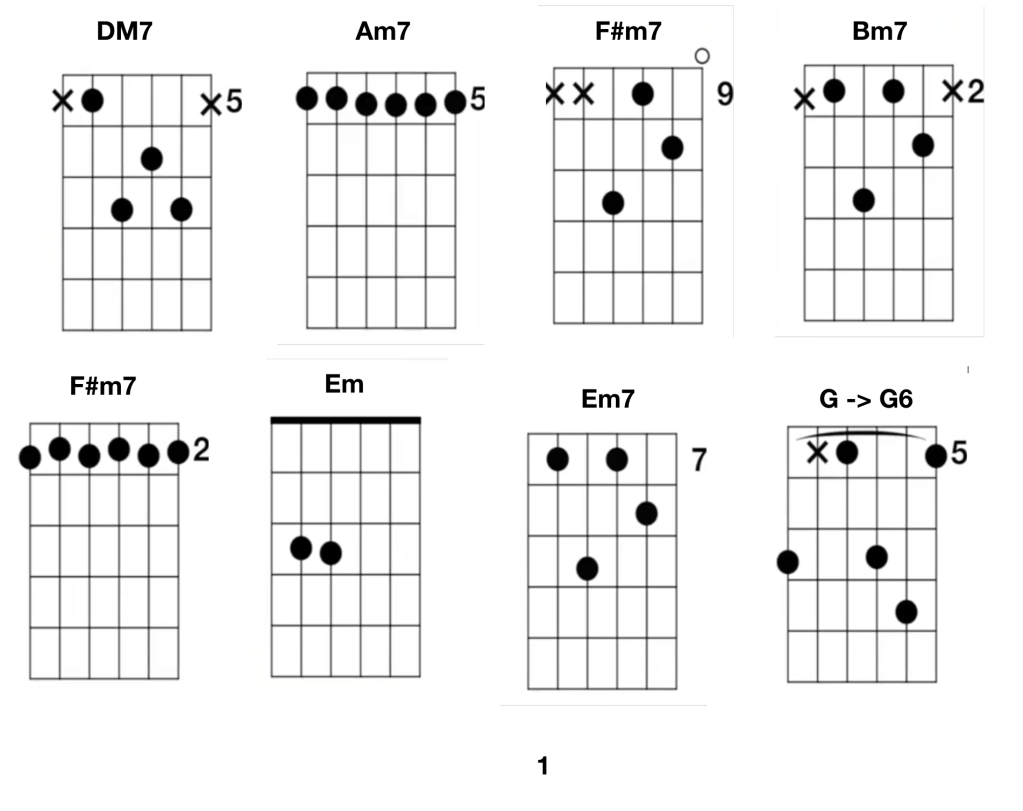
Last week, I posted this video of my instrumental cover of the Bacharach-David tune, “I’ll Never Fall in Love Again.” And I received several requests for the chart to my chord changes. So here it is, embedded in this video.

I strongly suggest slowing the video down to half speed, since some of the changes come very rapidly. And of course, you can always pause the video.

And here’s all the chords used in the piece in static view:

Hope this works for you and would appreciate hearing from you if it does. Subscribe to my blog to receive additional content and learn about new lessons as they are posted.

The Melody is in the Chords

It took me awhile as a guitarist to figure this out: If you want to play a melody look inside the chords.

I know, this sounds like a Yoda riddle, but here’s the thing: There are thousands of chords. There are only 12 notes to the scale. Every one of those notes belongs to a chord. This means that as you are playing the chords to a song, you more than likely are playing the notes contained in the melody. It is, of course, possible, that a note here and there is not part of that chord. That’s what makes it interesting.

But it means that you’re likely not more than a note or two away from a root, third, fifth, sixth, ninth, etc. of the chords that you’re playing. So as you play the chords, listen for the notes in the melody, and then work from there.

What’s more, if you learn and know your inversions for all those chords, it’s even more likely you will have the note for the melody you’re looking for as you progress through the song.

This is how you get to play the chords AND the melody simultaneously.

Here’s an example with the classic song from Burt Bacharach and Hal David: “I’ll Never Fall in Love Again.”

Harmonics and fret tapping

If you’ve been following my blog to date, you no doubt have noticed I love using harmonics and fret tapping as part of my style. Here’s an example where I combine the two techniques to produce some interesting percussive tones.

Don’t forget, if you would like to slow the video down to study the technique more, you can click on the little gear on the lower right side of the YouTube window and pick your speed.

As always, if you’re interested in learning more and staying up to date on my posts, click the FOLLOW over to the right of this blog.

Octaves and melody

One of the techniques in jazz that I think is underutilized in acoustic guitar playing is the use of octaves. Listen to any of the jazz greats — Joe Pass for instance — and you’ll discover how often they use octaves.

It’s a great method for emphasizing the melody and is sometimes even easier than trying to pick out the individual notes.

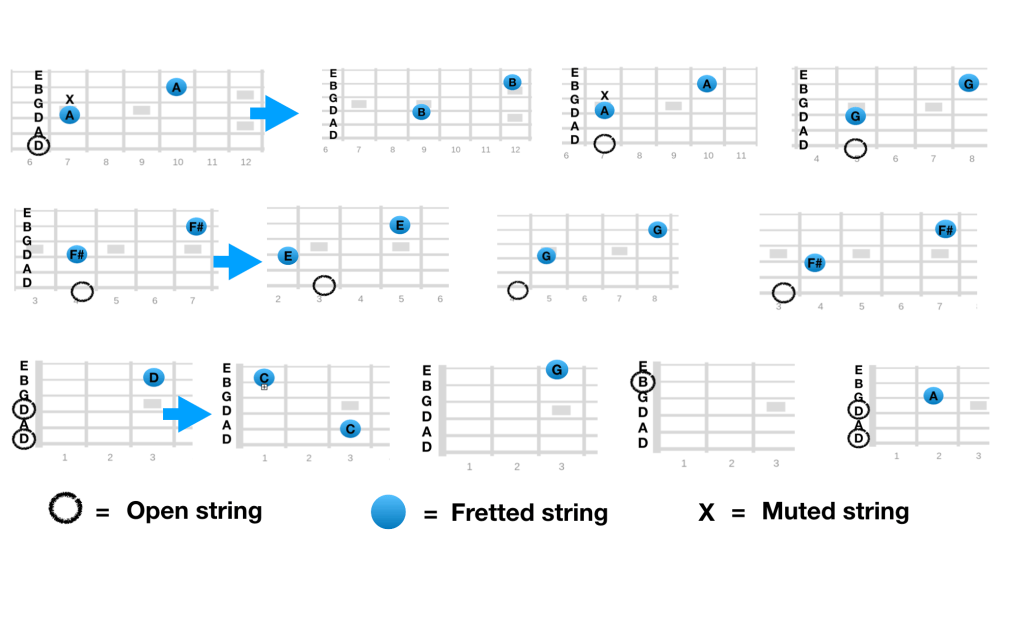
In this lesson, I’m going to continue with “Norwegian Wood” by John Lennon (The Beatles) and illustrate octaves as a way to play the melody. It helps that I am playing in a quasi-open tuning of “Drop D” (D-A-D-G-B-E) which is great for the key of D.

I’ve charted out the melody here. The arrows indicate to follow along from left to right, top to bottom.

And you can follow along to the actual progression in a slow-motion video here:

One thing to note is that I am not playing with a pick. I am picking the individual strings with my fingers. Now, it is possible to do this with a pick but you need to be careful to mute the middle string between the two strings that are forming the octave.

This can be done by just resting your index finger of the fretting hand slightly on that middle string.

Don’t forget to “follow” this blog (click button at top right of the page) for more handy tips and lessons!


I’m using Elixir 12-53 Nanowebs on my guitar. I find these strings last a lot longer than most and have a clear and bright sound. The link here is an affiliate link to Amazon, if you’re interested in trying them out.

Don’t forget to click the subscribe button below to stay up to date on my latest posts.