I was on a social forum the other day, where the perpetual discussion about my favorite music genre was raging.
A member of that forum noted that he had been criticized for describing Bossa Nova as jazz, and wondered whether he was in the wrong or right.
I agreed with the vast majority of the responses: Bossa Nova fits very neatly into the jazz genre. You don’t have to get far in the Real Book to find the very first evidence of that in “Blue Bossa” in Book 1.
Of course, there are purists who will argue that the Real Book does not define jazz. And they are right, but for the wrong reasons. Anything is jazz if it is treated as such. In fact, if you scroll through any manuscripts from the 20th Century, what you will find is a treasure of songs, many of which are now considered “jazz standards.”
Is “Over the Rainbow,” for instance, a jazz song? No, it was written, along with many other tunes in that era, as a popular song. That’s right, it was the equivalent of a Taylor Swift single today. (And if you’re following the news, you might have noted there is a new debate on the origins of that song.)
All this debating about what is jazz got me to think about an original Bossa Nova tune I wrote, titled “O Amor é um Milagre” (Love is a Miracle).
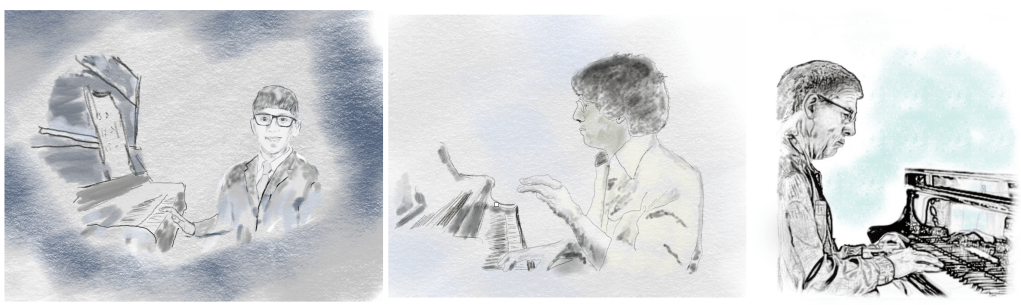
Self-portraits from three different phases of my piano-playing years.
THE FIRST INSTRUMENT I can remember picking up was a harmonica at the age of 4 years old. But my passion for music began in earnest when I wrote my first song, in 1965. Composing has been a passion — maybe even a compulsion — of mine ever since.
I have had prolific years and sparse years, but I have written every year since then. This collection represents a baker’s dozen of these songs, covering every decade from the ‘60s up until the ‘20s.
And finally, here are the individual songs. I’ve divided them into two volumes. Volume I is a bit more jazz and avant garde in style. Volume II contains more traditional or what might be considered modern “classical” music.
I hope you enjoy them. Here’s a little description of each:
VOLUME I
La Calle
Year: 2020
Key: A minor
Influence: Chick Corea
The first time I heard Corea was probably around 1973. I instantly was drawn to his fusion of traditional jazz and Latin rhythms.
La Calle
Lost & Found
Years: 1974, 1989
Key: Eb major
Influence: Joni Mitchell, Larry Coryell
This began as a guitar riff in 1974. I had taught it to a friend, then forgot all about it. Years later, we reunited for a jam session and he played the chord pattern. I named it “Lost and Found” on the spot and finished it up on piano that year.
Lost and Found
A Sample, But Not the Real McCoy
Year: 2011
Key: Db major
Influence: Joe Sample, McCoy Tyner, Herbie Hancock
Based on the influences of these three great pianists/composers from the era of Miles Davis through jazz fusion, so you can probably guess how I arrived at this title.
A Sample, But Not the Real McCoy
In a Roundabout Way
Year: 1992
Key: G major
Influence: Vince Guaraldi
Just a little ditty that I am pretty sure was inspired from the “Peanuts” TV specials when I was a kid. The piece is in 6/8 time, which has, to me, a feeling of a circular motion. Hence, the title.
In a Roundabout Way
Monk’s Mode
Influence: Thelonius Monk, Scott Joplin, Jo Ann Castle
Year: 2019
Key: F major
An homage to the ragtime and honky tonk piano composers and players.
Monk’s Mode
If Only We Two Weren’t Lonely, Too
Key: C major
Year: 2019
Influence: Bill Evans
This song pays tribute to the cool jazz ballads of the late ‘50s and ‘60s, in the style of tunes sung by Frank Sinatra or played by Stan Getz.
If Only We Two Weren’t Lonely, Too
VOLUME II
Angel’s Kitchen
Year: 2020
Key: B major
Influence: Frédéric Chopin, Robert Shumann, Ludwig van Beethoven
In the rural Connecticut of my youth, there was a favorite hiking trail with a cave known as “Devil’s Kitchen.” Being a good Catholic altar boy at the time, I christened a nearby rock to balance out the forces of good and evil. That memory came to me when writing this piece.
Angel’s Kitchen
Spider Dance
Year: 1974
Key: C minor
Inspirations: Keith Emerson, Béla Bartók, Igor Stravinsky
One of my first “serious” piano pieces. So named because the left hand pattern resembles a spider or maybe a crab in motion.
Spider Dance
Ingenuous You
Year: 2019
Key: E major
Influence: Frédéric Chopin, Robert Shumann
Just a little ditty in ¾ time, reminiscent of Chopin’s etudes and Shumann’s “Kinderszenen” collection, which I studied quite thoroughly (but never truly mastered) in my youth.
Ingenuous You
Opposable Thumbs
Key: Ab major
Year: 2009
Influence: Beethoven, Chopin, Claude Debussy, Maurice Ravel, Johann Sebastian Bach
For most of this tune, the two thumbs are crossed over one another resulting in a battle of the hands audible in the countermelody.
Opposable Thumbs
Indecision
Year: 1984
Key: D major
Influence: Claude Debussy, Maurice Ravel
I had always imagined this piece as a theme song for a children’s show. The title refers to constant modal changes that leave the melody unresolved.
Indecision
To the Top of Stony Hill Road
Year: 1966
Key: Gb major
Influence: Claude Paolini, Sr.
Reminiscent of the carefree days of my youth, walking up the hill to meet my best friend. This song is in the key that is principally played on the black keys and is derived from a little ditty my Dad taught me on the piano. The introduction is the chorus of the first song I wrote at the age of 10.
To the Top of Stony Hill Road
A Hymn for Her
Key: A major
Year: 2002
Influence: Stephen Foster, Paul Simon
I’ve always been fond of traditional American folk music and hymns of the 19th century. Sometime in the ’90s, I had picked up a Lutheran Hymnal in a used book store. Playing through that provided the inspiration for this piece.
A Hymn for Her
All proceeds from this album’s sales and streaming will be donated to the NAACP.
Thank you for reading about and listening to my music. Below are links to all the streaming and purchase platforms.
 George Paolini Music